
Executive Summary
Adobe Experience Manager as a Cloud Service (AEMaaCS) represents the future of enterprise content management. For organizations still operating on Adobe Managed Services or on-premise AEM, the question isn’t if you should migrate—it’s when and how.
At Valocity Digital, we’ve transformed the migration process by integrating artificial intelligence throughout every phase—from initial code analysis through refactoring, testing and validation. Our AI-enhanced methodology reduces migration timelines by up to 60% while improving code quality and reducing post-migration defects. This whitepaper provides digital leaders with a comprehensive understanding of why Cloud Service migration is essential, what considerations matter most, and how AI transforms this one-time transition into an efficient, intelligent workflow.
Why AEM Cloud Service Is Your Digital Future
The Cloud Service Imperative
Adobe has made its strategic direction clear: AEM as a Cloud Service is the platform’s future. While Adobe Managed Services and on-premise deployments remain supported, Adobe’s product innovation, feature development, and ecosystem investments flow exclusively to Cloud Service. Organizations delaying migration face mounting risks:
- Innovation Gap: New capabilities launch on Cloud Service months or years before availability elsewhere
- Security Exposure: Automatic security patching ensures Cloud Service environments remain protected
- Talent Challenges: Developers increasingly expect to work with modern, cloud-native platforms
- Competitive Disadvantage: Industry leaders have already made the transition
- No More Upgrades: Upgrades on Managed Service and on-premise are expensive, time consuming and disruptive – now all upgrades happen seamlessly and behind the scenes
The reality is simple: every AEM organization will eventually migrate to Cloud Service. The only question is when.
Financial Benefits That Matter
Predictable, Reduced Operational Costs
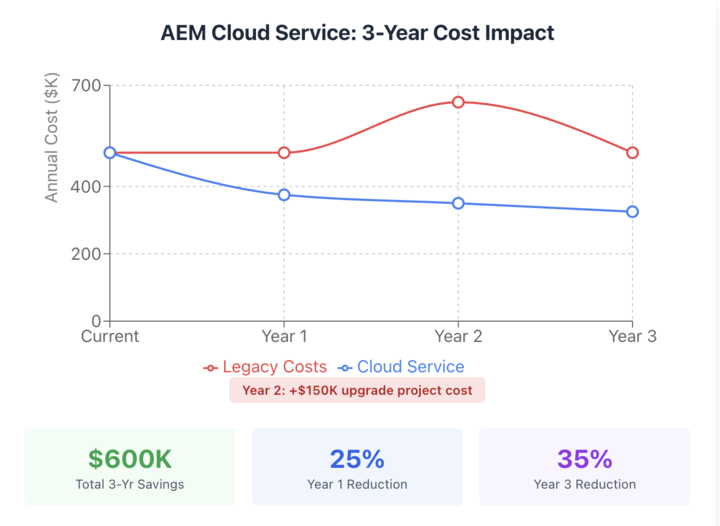
Cloud Service fundamentally changes AEM’s cost structure. Organizations typicallysee 25%1 reduction in IT spending, maintenance, and operations costs within the first year by eliminating:
- Capital expenditure on servers, storage, and data center infrastructure
- Dedicated operations teams for patching, monitoring, and capacity management
- Periodic upgrade projects consuming months of development resources
- Excess capacity maintained for peak traffic scenarios
Usage-Based Economics
Pay only for what you consume. The cloud-native model automatically scales resources based on actual demand, optimizing costs during low-traffic periods while ensuring performance during peak events. No more purchasing infrastructure for your busiest days of the year and leaving it idle the rest of the time.
Operational Excellence You Can’t Ignore
Always Current, Zero Downtime Updates
Forget version upgrades. Cloud Service delivers continuous product updates without service interruption. Your organization receives:
- Automatic security patches applied immediately upon availability
- New features and capabilities rolled out regularly
- Updates implemented transparently without disrupting operations
- Elimination of multi-month upgrade planning, testing, and deployment cycles
This isn’t incremental improvement—it’s a fundamental operational transformation. Teams redirect effort from maintenance to innovation, from upgrade testing to customer experience enhancement.
Intelligent, Automatic Scaling
Cloud Service responds instantly to traffic fluctuations, handling demand spikes of 200% or more without manual intervention. During Black Friday, major product launches, or viral content moments, the platform automatically:
- Adjusts computing resources based on real-time load
- Scales author and publish environments independently
- Maintains consistent performance during content publishing surges
- Scales down during low-traffic periods to optimize costs
Performance and Resilience Built In
The cloud-native architecture delivers measurable improvements impossible with traditional deployments:
- Global CDN: Built-in content delivery network ensures fast loading worldwide
- Automatic Failover: Disaster recovery and high availability without custom implementation
- 99.9% Uptime: Service level guarantees backed by Adobe infrastructure
- Load Distribution: Traffic automatically balanced across multiple containers
AI and Next-Generation Capabilities
Cloud Service provides native integration with Adobe’s AI innovations including Firefly for generative AI content creation, Sensei for intelligent automation across workflows, and GenStudio for AI-accelerated content supply chains. These capabilities aren’t add-ons—they’re fundamental platform features available only on Cloud Service.
The Productivity Transformation
Organizations migrating to Cloud Service report 25% higher productivity levels. Development teams focus on:
- Creating innovative customer experiences instead of infrastructure management
- Building new features instead of planning version upgrades
- Delivering a digital strategy instead of testing patch releases
- Experimenting with AI capabilities instead of capacity planning
This productivity shift compounds over time, creating an increasing separation between Cloud Service adopters and organizations remaining on legacy deployments.
Strategic Considerations Before Migration
Before beginning your Cloud Service migration, several key factors require evaluation to ensure a smooth, efficient transition.
AI-Powered Code and Architecture Assessment
Intelligent Analysis of Your Codebase
At Valocity Digital, we begin every migration with AI-enhanced code analysis that goes far beyond Adobe’s standard Best Practices Analyzer. Our approach combines:
Adobe’s Best Practices Analyzer (BPA): Adobe’s tool provides automated baseline analysis, identifying incompatibilities and deprecated patterns. The BPA generates comprehensive reports covering:
- Custom code using deprecated APIs
- Components requiring modernization
- Configuration patterns incompatible with cloud architecture
- Third-party dependencies needing updates
AI-Enhanced Deep Analysis: We augment BPA findings with proprietary AI analysis that:
- Analyzes Dependency Graphs: AI traces relationships across thousands of code files, identifying cascading impact of changes
- Detects Custom Patterns: Machine learning models trained on AEM codebases recognize unique patterns and anti-patterns that standard tools miss
- Predicts Migration Complexity: AI models trained on previous migration projects provide accurate effort estimates based on your specific codebase characteristics
- Prioritizes Refactoring: Intelligent ranking of which code modifications deliver the highest value and lowest risk
- Identifies Technical Debt: AI quantifies accumulated technical debt and recommends optimal remediation strategies
This combined approach delivers migration readiness assessments in days rather than weeks, with accuracy impossible through manual review alone.
Integration Strategy
Evaluating Connection Points
Cloud Service’s architecture requires modern integration patterns. Assessment areas include:
- Database Direct Connections: These require refactoring to API-based communication
- File System Dependencies: Must migrate to cloud storage solutions (Azure Blob Storage)
- Synchronous Processing Patterns: Long-running operations need asynchronous redesign
- Legacy Authentication Mechanisms: Update to OAuth 2.0 or JWT-based approaches
Well-architected integrations using RESTful APIs or message queues typically migrate smoothly. Legacy point-to-point connections require modernization.
Content Architecture Review
Content Volume and Structure
Understanding your content landscape informs migration strategy:
- Repository Size: Total content volume impacts transfer duration
- Structure Complexity: Deep hierarchies or complex relationships require careful planning
- Asset Management: DAM volume and metadata complexity
- Multi-Site Management: Blueprint structures and live copy configurations
Adobe’s Content Transfer Tool handles most scenarios effectively, but complex content architectures benefit from migration strategy planning.
Resource Planning and Team Readiness
Skills and Expertise Requirements
Cloud Service migration demands specific expertise:
- Cloud-Native Development: Understanding immutable areas, environment variables, and CI/CD patterns
- Refactoring Capabilities: Converting legacy code to cloud-compatible implementations
- Integration Architecture: Designing modern, resilient integration patterns
- DevOps Knowledge: Leveraging Cloud Manager’s deployment pipelines effectively
Organizations must evaluate internal team capabilities honestly. Gaps in cloud-native expertise create migration risk and timeline uncertainty—which is precisely why working with an experienced partner accelerates success.
Migration from Adobe Managed Services
For organizations currently on Adobe Managed Services, you’re already operating in a cloud-hosted environment—but that’s where the similarity to Cloud Service ends. Understanding the differences and planning accordingly ensures efficient migration.
The Upgrade Challenge on Managed Services
Time-Consuming, Expensive, Recurring
One of the most compelling reasons to migrate from Managed Services is escaping the upgrade treadmill. On Managed Services, staying current requires:
- Quarterly Service Pack Updates: Each requiring regression testing across your entire implementation
- Annual Version Upgrades: Major upgrades consuming 2-4 months of development effort every 12-18 months
- Custom Code Regression: Every upgrade risks breaking custom implementations
- Testing Overhead: Comprehensive validation needed before each production deployment
- Deployment Complexity: Coordinating downtime windows and rollback procedures
These recurring upgrade projects consume significant budget and resources that could drive business value instead. Each upgrade cycle costs organizations tens or hundreds of thousands of dollars in development time, testing effort, and opportunity cost.
On Cloud Service, this entire paradigm disappears. Updates happen automatically, transparently, and continuously without disruption.
Cloud Manager: Your Migration Advantage
If you’re already using Cloud Manager with Managed Services, you have a significant head start. Cloud Manager is the deployment mechanism for Cloud Service, and your team’s existing experience transfers directly:
- CI/CD Pipeline Configuration: Patterns remain consistent
- Code Quality Gates: Same validation rules and quality checks
- Deployment Orchestration: Familiar workflows and processes
- Environment Management: Similar concepts with enhanced automation
The primary difference is enhanced automation and additional cloud-native capabilities. Your team’s Cloud Manager expertise accelerates Cloud Service adoption.
AI-Accelerated Migration Approach for Managed Services
Leveraging Automated Tools with AI Enhancement
Adobe provides comprehensive migration tooling, and we enhance these with AI capabilities:
Adobe’s Core Migration Tools:
- Repository Modernizer: Restructures projects into cloud-compatible package formats
- Dispatcher Converter: Transforms AMS dispatcher configurations to Cloud Service compatibility
- Index Converter: Migrates Custom Oak Index Definitions to cloud-compatible versions
- Code Transformer: Uses pattern recognition to detect and update incompatible code segments
Valocity Digital’s AI Enhancement Layer:
Our AI-powered migration platform works alongside Adobe’s tools to dramatically accelerate the process:
Intelligent Code Refactoring
- Pattern Recognition: AI analyzes your codebase and automatically identifies refactoring opportunities that Adobe’s tools might miss
- Context-Aware Transformation: Unlike simple find-and-replace, our AI understands code context and suggests refactoring approaches that maintain business logic while modernizing implementation
- Bulk Modernization: AI handles repetitive refactoring patterns across hundreds of files simultaneously—converting OSGi configurations from XML to JSON, updating Sling Models, modernizing component patterns
- Legacy Pattern Translation: AI trained on AEM evolution translates legacy foundation components to Core Components while preserving functionality
AI-Generated Migration Scripts
- Custom Content Migration: AI creates tailored scripts for complex content transformations based on your specific requirements
- Conditional Logic: Handles sophisticated migration scenarios with branching logic and validation rules
- Filter Criteria: Intelligently migrates content based on metadata, structure, or business rules
Most standard Managed Services configurations convert smoothly through this AI-enhanced approach, with manual refinement needed only for highly specialized business logic or unique architectural decisions.
Integration Modernization with AI Assistance
While many integrations migrate without issues, some patterns require updates:
- Secret Management: Moving from encrypted OSGi configurations to Cloud Manager environment variables
- Authentication Updates: Implementing cloud-compatible authentication patterns
- API Modernization: Replacing deprecated endpoints with current cloud-supported APIs
- Resilience Patterns: Adding circuit breakers, retries, and fallback mechanisms
AI accelerates integration updates by:
- Analyzing integration code and automatically generating cloud-compatible equivalents
- Creating authentication and error handling patterns aligned with best practices
- Producing integration test scenarios for validation
- Documenting changes for future team reference
Content Migration
Adobe’s Content Transfer Tool efficiently migrates content from Managed Services to Cloud Service, with our AI enhancement adding:
- Intelligent Content Classification: AI automatically organizes and tags content during migration
- Quality Validation: AI-powered checks ensure content integrity throughout transfer
- Metadata Enrichment: Machine learning generates missing metadata and improves discoverability
- Duplicate Detection: AI identifies redundant content that can be consolidated
Additional Considerations for On-Premise Customers
On-premise AEM deployments face additional migration complexities beyond what Managed Services customers encounter. The shift to Cloud delivers not only huge cost savings and unlocks a huge number of additional services, but it enables a level of flexibility and speed to market that will change the way businesses think about updates to their digital properties.
The Infrastructure Paradigm Shift
From Fixed to Elastic
On-premise AEM relies on your company’s physical or virtual servers, with processing capacity determined by local infrastructure. Moving to cloud requires reconceptualizing fundamental operational assumptions:
- Capacity Planning: From fixed infrastructure investments to elastic, demand-driven scaling
- Operations Model: From self-managed server administration to Adobe-managed cloud infrastructure
- Deployment Process: From direct server access to CI/CD automation via Cloud Manager
- Monitoring Approach: From custom tooling to Cloud Manager’s built-in observability
This paradigm shift represents both challenge and opportunity. Organizations must adapt operational processes while gaining capabilities impossible with on-premise deployments.
AI-Powered Legacy Code Modernization
Accumulated Technical Debt
On-premise implementations often contain older code patterns accumulated over years or decades. This is where AI delivers the most dramatic value.
Traditional Modernization Challenges:
- Static Templates: Converting to editable templates using AEM Modernization Tools
- Classic UI Components: Updating to Touch UI and Core Components
- Foundation Components: Migrating to Core Components for long-term maintainability
- Custom Workflows: Refactoring for cloud-native asset processing microservices
- Deprecated API Usage: Replacing outdated API calls with current equivalents
How AI Transforms Legacy Modernization:
Codebase Intelligence: AI analyzes your entire codebase—even implementations spanning millions of lines developed over decades—and creates comprehensive modernization plans. The AI:
- Identifies every deprecated pattern across all modules
- Maps dependencies between legacy components
- Suggests optimal migration sequence to minimize risk
- Estimates effort for each modernization phase
Automated Code Translation: For patterns like foundation component to Core Component migration, AI:
- Analyzes existing component functionality and business logic
- Generates Core Component implementations that preserve behavior
- Creates necessary supporting configuration and styling
- Produces comprehensive test cases for validation
Workflow Refactoring: Converting custom DAM workflows to cloud-native asset microservices involves complex logic translation. AI:
- Documents existing workflow behavior and business rules
- Designs cloud-native processing pipeline equivalents
- Generates implementation code for custom processing steps
- Creates migration validation criteria
Quality Assurance: Perhaps most importantly, AI catches issues human reviewers miss:
- Detects subtle breaking changes in refactored code
- Identifies edge cases that require special handling
- Validates that business logic remains consistent
- Generates regression test suites covering all scenarios
The Best Practices Analyzer typically identifies more issues in on-premise environments than Managed Services installations. AI transforms this mountain of technical debt from an overwhelming challenge into a structured, manageable modernization process.
Configuration Consolidation
Scattered Configuration Management
On-premise environments typically have configuration distributed across multiple locations and management approaches. Cloud Service requires:
- Configuration Consolidation: Centralizing environment-specific settings
- Secret Externalization: Moving credentials to Cloud Manager environment variables
- Immutable Area Understanding: /apps and /libs cannot be modified at runtime
- Cloud-Compatible Run Modes: Adapting configuration strategies for cloud deployment
AI assists by analyzing existing configurations across environments, identifying inconsistencies, and generating standardized cloud-compatible configuration sets.
Network and Security Architecture Updates
Security Model Transformation
Transitioning from on-premise security requires updating:
- Firewall Rules: Adapting network access patterns for cloud architecture
- Authentication Frameworks: Modernizing identity and access management
- VPN Configuration: Establishing secure connectivity to cloud environments
- Compliance Requirements: Validating data residency and regulatory alignment
Organizations in regulated industries should engage compliance and security teams early in migration planning.
The Extended Upgrade Challenge
Years Without Major Upgrades
Many on-premise organizations operate versions several years old, having delayed major upgrades due to cost and complexity. This creates:
- Larger Feature Gaps: More extensive differences between current state and Cloud Service
- Accumulated Technical Debt: Years of deprecated patterns and outdated dependencies
- Testing Complexity: Greater unknown risk in custom implementations
- Team Knowledge Gaps: Developers may lack experience with modern AEM patterns
AI bridges these gaps by essentially teaching itself your legacy implementation—understanding business logic, identifying patterns, and suggesting modern equivalents that preserve functionality while adopting current best practices.
Why On-Premise Customers Benefit Most from AI
On-premise organizations gain the largest transformation value from AI-accelerated migration:
- Legacy Code Translation: AI handles years of accumulated custom code efficiently
- Technical Debt Remediation: Automated identification and resolution of long-standing issues
- Knowledge Capture: AI documents legacy implementations as it modernizes them
- Risk Reduction: Comprehensive AI testing catches issues before production deployment
- Timeline Compression: Migrations that would take 12-18 months complete in 3-6 months
The gap between on-premise capabilities and Cloud Service functionality is substantial. AI makes bridging that gap not just feasible but efficient.
AI-Enhanced Testing and Quality Assurance
One of the most significant ways AI transforms migration is through comprehensive, intelligent testing that ensures your Cloud Service implementation works flawlessly from day one.
Traditional Testing Challenges
Manual migration testing faces inherent limitations:
- Coverage Gaps: Human testers can’t possibly validate every code path and scenario
- Regression Risks: Changes in one area break functionality elsewhere, discovered only after deployment
- Time Constraints: Thorough testing extends project timelines significantly
- Tribal Knowledge: Testing often relies on team members remembering edge cases and business rules
AI-Powered Testing Revolution
Automated Test Generation
Our AI testing platform creates comprehensive test suites automatically:
Functional Test Coverage: AI analyzes your codebase and generates tests for:
- Every component and its various configurations
- All user interaction workflows
- Content authoring scenarios across templates
- Publishing and activation processes
- Integration endpoints and data flows
Edge Case Identification: AI identifies and tests scenarios human testers might miss:
- Unusual content structures or data combinations
- Error handling for integration failures
- Performance under various load conditions
- Security boundary testing
Regression Test Suites: AI generates tests specifically designed to catch breaking changes:
- Comparing behavior between source and target environments
- Validating business logic preservation after refactoring
- Ensuring content renders identically across platforms
- Verifying integration responses remain consistent
Intelligent Test Execution
Self-Healing Tests: Traditional automated tests break when UI elements change. Our AI-powered tests adapt automatically:
- Recognizing equivalent elements even when identifiers change
- Understanding functional intent rather than just clicking specific buttons
- Adapting to minor UI variations without manual test updates
Prioritized Test Runs: AI determines which tests matter most:
- Running high-risk area tests first
- Focusing on recently modified code
- Adapting test priority based on failure patterns
- Optimizing test execution time while maximizing coverage
Continuous Quality Monitoring
Post-Migration Validation: After migration completes, AI continues monitoring:
Content Integrity Checks:
- Comparing content between source and target systems
- Identifying missing assets or broken references
- Validating metadata preservation
- Detecting rendering differences
Performance Analysis:
- Establishing baseline performance metrics
- Identifying performance regressions
- Detecting resource bottlenecks
- Optimizing content delivery patterns
Security Scanning:
- Vulnerability detection in custom code
- Configuration security validation
- Access control verification
- Compliance requirement checking
The AI Testing Advantage
Organizations using AI-enhanced testing report:
- 60% faster test creation: Automated generation vs. manual test writing
- 40% fewer post-migration defects: Comprehensive coverage catches issues early
- 90% reduction in regression bugs: AI identifies breaking changes before deployment
- 75% reduction in testing timeline: Parallel AI execution vs. sequential manual testing
Perhaps most importantly, AI testing provides confidence. You deploy to Cloud Service knowing that your implementation has been validated more thoroughly than any manual process could achieve.
The One-Time Migration: Why AI-Enhanced Expertise Matters
Here’s the critical insight many organizations miss: migrating to AEM Cloud Service is a one-time event. Once you’re on Cloud Service, you never upgrade again. Updates happen automatically. Features arrive continuously. This is the last major AEM migration your organization will ever execute.
The Economics of AI-Enhanced Expertise
This Isn’t Routine Maintenance
Because Cloud Service migration happens once, approaching it as routine internal development work misses the strategic reality. Consider:
- Specialized Knowledge Requirements: Cloud-native patterns, Adobe tooling expertise, migration best practices, and AI-enhanced methodologies aren’t everyday development skills
- Compressed Learning Curve: Internal teams learning migration nuances in real-time on production systems
- Opportunity Cost: Senior developers spending months on migration instead of revenue-generating features
- Risk Exposure: Mistakes made during migration create technical debt lasting years
Organizations that approach migration as “just another development project” consistently underestimate complexity, extend timelines, and deliver suboptimal results.
The Valocity Digital AI Advantage
Specialized Migration Expertise Enhanced by AI
Valocity Digital brings deep AEM expertise and proven Cloud Service migration experience, amplified by our proprietary AI-enhanced methodology. We’ve guided organizations across both Managed Services and on-premise deployments through successful migrations, understanding the patterns, pitfalls, and optimization opportunities that come from repetition.
Our AI-enhanced approach delivers:
- 60% Faster Timelines: AI-automated code analysis, refactoring, and testing compress migration duration dramatically
- Superior Code Quality: AI catches issues human reviewers miss and suggests optimizations beyond basic compatibility
- Reduced Risk: Comprehensive AI testing validates every aspect of your migration before production deployment
- Knowledge Transfer: Your team learns cloud-native patterns while AI handles repetitive modernization tasks
Our AI-Enhanced Process:
Phase 1: Intelligent Discovery
- AI-powered codebase analysis identifying all migration requirements
- Automated effort estimation based on machine learning models
- Risk assessment highlighting potential complications
- Migration roadmap with optimized task sequencing
Phase 2: Accelerated Refactoring
- AI-automated code modernization for standard patterns
- Expert developer review and enhancement of AI-generated code
- AI-generated integration updates and test scenarios
- Continuous validation ensuring business logic preservation
Phase 3: Comprehensive AI Testing
- Automated test suite generation covering all functionality
- AI-powered regression testing across environments
- Performance validation and optimization recommendations
- Security scanning and compliance verification
Phase 4: Validated Deployment
- AI-monitored content migration with integrity validation
- Parallel environment testing with automated comparison
- Production deployment with AI-powered smoke testing
- Post-migration monitoring and optimization
Building for the Future
Modern Foundation Implementation
Migration isn’t just about moving existing implementations to new infrastructure—it’s about establishing the modern foundation that will serve your organization for years. We ensure your Cloud Service implementation follows:
- Adobe Digital Foundation Blueprint: Lean, agile development principles enabling rapid iteration
- Core Components Strategy: Minimizing custom code in favor of Adobe-maintained best practices
- Composable Architecture: API-first integration patterns supporting future flexibility
- Cloud-Native Patterns: Leveraging microservices, event-driven design, and serverless computing
Preparing for Next-Generation Adobe Services
Your Cloud Service implementation positions you for Adobe’s AI-powered product roadmap:
- Adobe GenStudio Integration: AI-powered content supply chain acceleration
- Experience Cloud Alignment: Seamless integration with Adobe Real-Time CDP, Journey Optimizer, and Analytics
- Firefly Services: Access to generative AI capabilities for content creation at scale
- Universal Editor: Modern content editing capabilities across channels
The Internal Team Reality
Why Internal Migration Attempts Struggle
Organizations attempting in-house Cloud Service migration face consistent challenges:
- Knowledge Gaps: Cloud-native development patterns and AI integration expertise differ significantly from traditional AEM
- Tooling Unfamiliarity: Adobe migration tools and AI acceleration platforms require experience to use effectively
- Hidden Complexity: Issues that appear simple often reveal architectural challenges
- Limited AI Access: Most organizations lack proprietary AI migration platforms and trained models
- Timeline Optimism: Internal estimates consistently underestimate actual migration effort without AI acceleration
- Competing Priorities: Business-as-usual development work competes for developer attention
The most common outcome? Extended timelines, budget overruns, and compromised implementations that require costly remediation.
The Partnership Approach
Collaborative Success with AI Augmentation
Working with Valocity Digital doesn’t mean your team sits on the sidelines. We believe in collaborative engagement where AI handles repetitive tasks while human expertise focuses on strategic decisions:
- Knowledge Transfer: Your team learns cloud-native patterns throughout the process
- Hands-On Involvement: Internal developers work alongside our experts on complex migration decisions
- Capability Building: Your team finishes migration ready to develop on Cloud Service independently
- AI Tooling Access: We share our AI methodologies and approaches, upskilling your team on AI-enhanced development
Accelerated Value Realization
Bringing in AI-enhanced specialized expertise compresses migration timelines, allowing you to:
- Capture Cloud Service Benefits Sooner: Begin realizing operational savings and innovation access faster
- Minimize Business Disruption: Efficient AI-accelerated migration reduces impact on ongoing operations
- Avoid False Starts: Get it right the first time instead of course-correcting mid-project
- Free Internal Resources: Keep your development team focused on revenue-generating features while AI handles migration grunt work
The One-Time Investment
Because this migration only happens once, the decision point is straightforward: invest appropriately in AI-enhanced specialized expertise to ensure success, or risk extended timelines, suboptimal outcomes, and technical debt that persists for years.
Most organizations discover that partnering with an AI-enhanced agency like Valocity Digital:
- Costs less than extended internal team allocation when fully accounting for opportunity cost
- Delivers 60% faster by leveraging AI automation for repetitive tasks
- Produces superior results through AI-optimized code and comprehensive automated testing
- Reduces risk dramatically by catching issues before production through AI validation
Conclusion: The AI-Accelerated Path Forward
The question facing every AEM organization is no longer whether to migrate to Cloud Service—Adobe has made that direction clear. The question is: when will you migrate, and will you leverage AI to make it more efficient, or will you struggle through manual processes?
Every month you remain on Managed Services or on-premise deployments, the gap widens:
- Competitors gain operational efficiency advantages
- Your team works with older tooling and patterns
- Adobe releases features you can’t access
- Technical debt accumulates
- Talented developers seek modern platforms elsewhere
Cloud Service migration is inevitable. But it’s also a one-time transformation that positions your organization for the next decade of digital experience innovation.
Valocity Digital brings specialized expertise, proven methodology, and proprietary AI-enhanced capabilities that reduce migration timelines by 60% while improving quality and reducing risk. We’ve guided organizations through this journey successfully, leveraging AI to handle the complexity while ensuring your team gains the knowledge needed for long-term Cloud Service success.
The AI revolution in software migration is here. Organizations that embrace it complete their Cloud Service transitions faster, with better outcomes, and at lower total cost than those relying on traditional manual approaches.
Ready to discuss your AI-accelerated Cloud Service migration?
Contact Valocity Digital at business@valocitydigital.com to start the conversation. Let’s ensure your one-time migration leverages AI to deliver maximum value and positions you for long-term success.
References
- https://business.adobe.com/resources/reports/the-total-economic-impact-of-adobe-experience-cloud.html?utm_source=chatgpt.com#get-the-total-economic-impact-study-and-learn-about-the-cost-savings-and-business-benefits-of-adobe-experience-cloud