

We’ve implemented dozens of marketing platforms over the years, but Adobe Journey Optimizer (AJO) represents something fundamentally different. It’s not just another tool in the martech stack—it’s a shift in how businesses can orchestrate customer experiences at scale.
The Problem With Traditional Marketing Automation
Most marketing platforms treat customer interactions as discrete events: someone opens an email, clicks a link, visits a page. You set up workflows based on these triggers, and you’re done. This worked when customer journeys were more predictable and channels were siloed, but that hasn’t been the case for a long time.
But today’s customers don’t follow predictable paths. They research on mobile, purchase on desktop, reach out via chat, and expect you to know who they are across every touchpoint. Traditional automation creates fragmented experiences because it wasn’t built for this reality. Ultimately, the traditional approach we used of defining a set of segments or cohorts for customers and then unilaterally defining which ones they belong in and assuming they are static, doesn’t work and AJO blows up that model entirely by dynamically creating and slotting those buckets.
What Makes AJO Different
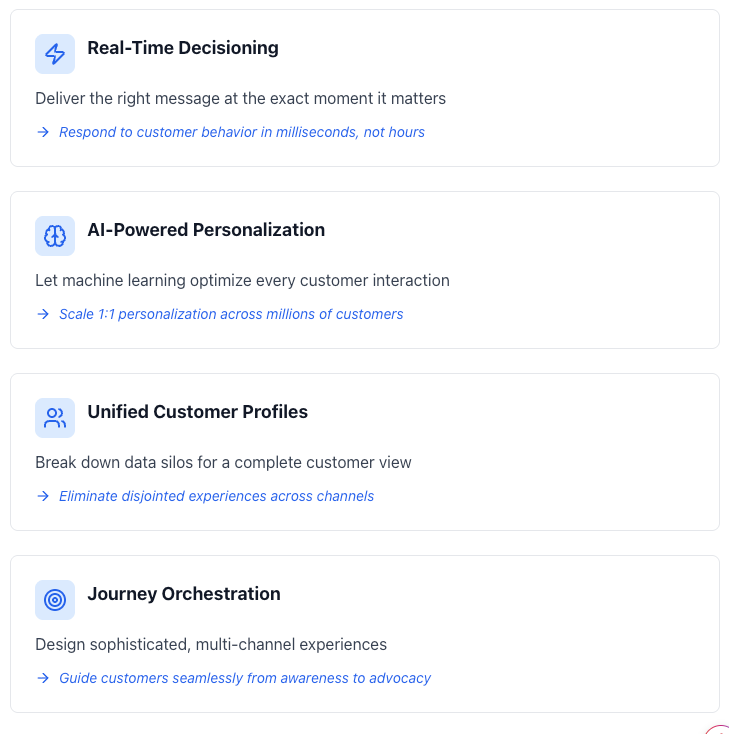
Adobe Journey Optimizer utilizes the Adobe Experience Platform, which means it has access to real-time, unified customer profiles. This architectural difference changes everything about what’s possible.
Real-World Impact: What We’ve Seen
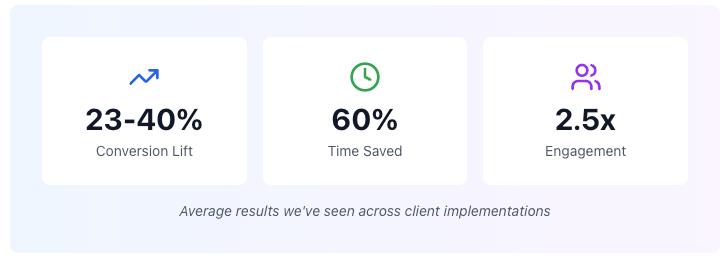
Theory is one thing, but let’s talk about actual results. We recently helped a mid-sized e-commerce retailer implement AJO, replacing their legacy ESP and basic recommendation engine.
Within 90 days, they saw abandoned cart recovery rates improve by 34%, not because we wrote better email copy, but because AJO could identify the optimal time, channel, and offer for each individual customer. Someone who browses on mobile at night gets a push notification the next morning. Someone who always uses a desktop gets an email timed to their typical browsing pattern.
More importantly, their team went from spending 15 hours per week manually segmenting audiences involving data engineers to spending that time on strategy and creative—the work that actually moves the needle.
The Three Capabilities That Actually Matter
AJO has dozens of features, but in our experience, three capabilities deliver the most immediate business value:
Decision management that actually works. Most personalization engines require data scientists to build and maintain complex models. AJO’s offer decisioning uses AI to automatically learn which offers perform best for which customers, and it gets smarter over time without constant tuning.
Cross-channel orchestration without the headache. You can design a journey once and AJO handles the complexity of executing it across email, SMS, push, web, and app—including the timing, frequency capping, and preference management that usually requires custom development.
Real-time personalization at scale. When someone visits your site, AJO can instantly pull their unified profile, apply business rules and AI models, and deliver personalized content—all in under 100 milliseconds. This isn’t batch processing overnight; it’s true real-time.
Is AJO Right for Your Business?
Here’s the honest answer: AJO isn’t for everyone. If you’re a small business doing under $10M in revenue, you probably don’t need this level of sophistication yet. A simpler tool will serve you better.
But if you’re experiencing any of these challenges, AJO deserves serious consideration:
- Your customer data lives in multiple systems and you can’t get a complete view of customer behavior.
- Your marketing team spends more time managing tools than building strategy.
- You know personalization works but can’t scale it beyond basic segmentation.
- Your customers interact across multiple channels but you can’t coordinate experiences.
- You want to expand A/B testing but don’t have the resources.
- You’re losing deals because competitors are delivering more relevant, timely experiences.
What Implementation Actually Looks Like
This is where agencies often oversell. They promise quick wins and downplay the change management required. The truth is, implementing AJO is a strategic initiative, not a platform swap.
You need clean data pipelines into Adobe Experience Platform. You need cross-functional alignment between marketing, IT, and analytics. You need to rethink your campaign planning process because batch-and-blast doesn’t make sense anymore.
Done right, initial implementation typically takes 3-4 months, with meaningful results visible within the first 60 days. But the real value compounds over time as your team masters the platform and your AI models get smarter.
The Bottom Line
Adobe Journey Optimizer represents where customer experience technology is heading: unified data, AI-powered decisioning, and real-time orchestration across every touchpoint. For businesses ready to move beyond campaign-based marketing toward true journey orchestration, it’s one of the most powerful platforms available.
But it requires commitment—to clean data, to cross-functional collaboration, and to fundamentally rethink how you engage customers. If you’re ready for that transformation, the results can be remarkable.
Ready to explore if AJO is right for your business?
At Valocity Digital, we’ve helped companies across retail, financial services, and B2B implement Adobe Journey Optimizer. Let’s have an honest conversation about whether it makes sense for your organization. Click here to start monetizing your customer interactions.