

How AI and a connected operating model turn buying-group signals into coordinated action and measurable growth
In a single week, a target account can see a display ad, engage with social content, visit the website, attend a webinar and hear from a sales representative. Every interaction can register as engagement while the account itself moves no closer to a decision.
That is the unfinished promise of ABX (Account Based Experience). Most organizations can identify target accounts and measure activity. Far fewer can turn signals from multiple members of a buying group into coordinated action, meaningful account progression and measurable pipeline.
AI is making every part of the marketing stack more capable. It can interpret intent, accelerate research, create content variations, optimize media and prepare sellers for outreach. But AI operating independently inside individual platforms can also produce faster fragmentation. Realizing the promise of ABX requires those capabilities to work together around the account.
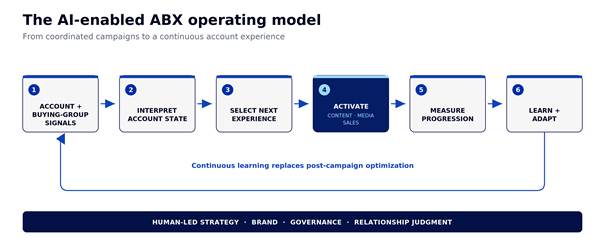
A connected operating model turns account signals into coordinated experiences, action and learning.
Engagement is evidence, not the outcome
ABM established the discipline of selecting and prioritizing the accounts that matter most. ABX extends that discipline to the experience of the entire buying group: what each stakeholder needs, what the account already knows, which signals it has given and what should logically happen next.
Paid media, search, social, website content, email, events, executive engagement, Sales outreach, partner activity and customer references can all contribute. But clicks, visits and content consumption are leading indicators. Their value depends on whether they broaden buying-group participation, change what the account does next or help an opportunity advance. ABX asks those interactions to build on one another instead of arriving as unrelated activity.
Account progression starts with a shared view
Marketing and Sales platforms each capture a slice of the truth: firmographics, intent, media exposure, website activity, content engagement, events, opportunity data and seller interactions. Each system may use AI to interpret its own data while still holding a different view of the same account. Useful intelligence starts with reconciling account and contact identities, agreeing on buying stages and making the signals that matter available across systems.
On that foundation, AI can help teams see which buying-group members are active, which roles are missing, what problems are drawing attention and whether engagement is expanding or narrowing. A shared account view gives Marketing and Sales one starting point for deciding what the account needs next.
The operating model turns that shared view into decisions: which signals matter, who interprets them, which actions they trigger and how quickly a system or team should respond. Strategists, sellers and account teams add the relationship context and judgment that a platform-level recommendation cannot provide on its own.
AI turns insight into coordinated action
Generative AI dramatically reduces the time required to research accounts and create content variations by industry, persona, account tier, journey stage and market. But producing more assets is not the objective. The objective is to deliver the most useful experience for the next decision the buying group needs to make.
A shared campaign idea, messaging architecture and approved source library provide the foundation. AI creates controlled variations; defined workflows route them through brand, subject-matter and market review; and connections to activation platforms ensure the approved experience reaches the right audience at the right point in the journey. Personalization becomes a repeatable process across 1:many, 1:few and 1:1 programs, with ownership from initial insight through publication and performance feedback.
Media should respond to account progression
Paid media is often managed as a parallel discipline and optimized around impressions, clicks, cost per lead and conversion. Those measures remain useful, but ABX gives media a more specific role: helping the buying group move from its current state to the next one.
One account may need broader awareness across the buying group. Another may need technical validation. An active opportunity may need customer evidence rather than another product ad. Account intelligence and opportunity status should influence audience selection, messaging and channel sequence. Performance then returns to the shared account view so teams can evaluate not only cost and conversion, but which interactions contributed to meaningful progression.
Sales activation is part of the journey
ABX breaks down when Marketing creates engagement and Sales receives little more than an alert that something happened. The Sales action must be designed alongside the marketing experience, with the account context, content and timing needed to make the outreach relevant.
AI can assemble account research, summarize buying-group engagement and recommend approved content or outreach. That context has to reach sellers inside their normal workflow, with clear ownership and timing for the next action. Seller feedback must then return to Marketing so subsequent experiences reflect what actually happened in the conversation. The quality of the handoff determines whether the journey feels coordinated or accidental.
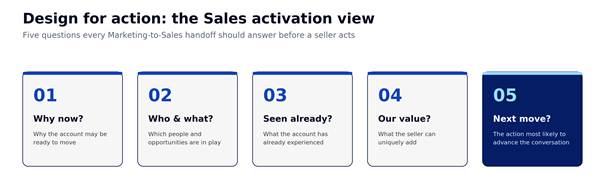
A useful Sales activation view answers five questions before a seller acts.
Global ABX requires local relevance
As programs expand across markets, personalization becomes more complex. Language is only one variable. Search behavior, channel usage, terminology, regulation, culture and buying expectations also change by market. A campaign that works well in one country can feel generic, irrelevant or unnatural in another.
AI accelerates adaptation and localization; in-market specialists judge linguistic, cultural and channel fit. A unified workflow connects their review to approved source content, version control and local activation, preserving the strategic idea while adapting the experience to the audience.
Measure progression, not isolated activity
ABX measurement should show how an account and its buying group are changing over time. No single impression, download or meeting should receive credit for creating a deal. Instead, teams need a progression model that connects leading indicators to commercial outcomes:
- Qualified reach – Are the right accounts and buying-group roles seeing the program?
- Buying-group coverage – Is engagement expanding across the people involved in the decision?
- Meaningful engagement – Are buyers consuming content that signals a relevant problem or need?
- Account progression – Is the account moving to a more advanced stage or taking a higher-value action?
- Opportunity movement – Is the program helping create, accelerate or expand an opportunity?
- Pipeline, revenue and learning – What commercial value resulted, and what should change next?
This approach treats engagement as evidence rather than an endpoint. Cohort analysis, stage progression, buying-group coverage, Sales feedback and controlled experiments provide a more credible view of contribution than forcing every touch into a single-attribution claim. AI can surface patterns across those measures, but the operating model determines whether the finding changes the next decision.
Governance keeps scale from amplifying mistakes
As more platforms generate recommendations and content, their individual controls must fit an enterprise-wide approach. Without one, teams can scale inconsistent messaging, conflicting actions and disconnected experiences alongside production volume.
That approach requires approved sources and claims, brand standards, privacy controls, risk-based human review, transparent approvals and an auditable record of decisions. Accountability must cross platform and team boundaries so it is always clear who can approve an experience, activate it and respond when it needs to change.
The operating model behind the promise
The Valocity TransPerfect Collective combines Valocity Digital’s expertise in strategy, customer experience, creative, technology and data with TransPerfect Digital’s enterprise-scale media, analytics, production, localization and global-market capabilities. Together, those disciplines connect account intelligence with experience development, activation, Sales action and learning.
The model aligns a shared account view with journey decisions, content workflows, media activation and global adaptation. AURA, TransPerfect Digital’s governed marketing AI platform, accelerates research, content variation, localization, compliance workflows and performance intelligence inside that model, while experienced practitioners remain accountable for strategy, quality and decisions.
This addresses the work that otherwise falls between platforms and teams: maintaining the connections, defining the decision rules, coordinating the handoffs and applying what the organization learns. Technology capability is joined to the operational capacity required to deliver ABX across accounts, channels and markets.
From engagement to pipeline
The promise of ABX is not better engagement reporting. It is the ability to learn from engagement and turn that intelligence into coordinated action – helping buying groups progress, opportunities move and Marketing and Sales create pipeline together.
Achieving that promise takes connected data, maintained integrations and shared ways of working across Marketing, Sales and delivery. AI accelerates the work inside the system; the operating model connects it from the first account signal through the next experience and into measurable business results.
Where does engagement stop translating into account progression? Let’s map the data, workflows and handoffs that can move your ABX program from activity to pipeline. Start the conversation at valocitydigital.com.