
Your enterprise has automated its supply chain, its software releases and its content operations. So why does it still take weeks — sometimes months — to turn a great idea into a live digital experience?
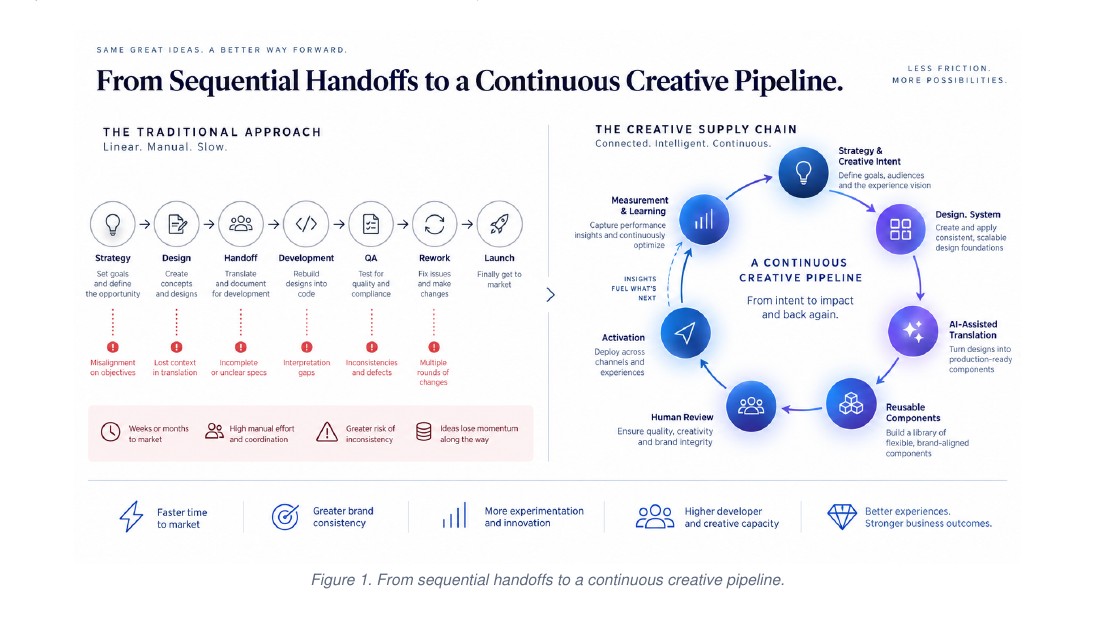
The answer is the last unoptimized mile: the handoff between creative intent and production-ready code. A concept becomes a design. The design is handed to development. Developers interpret and rebuild it. QA finds inconsistencies. And the cycle repeats. Every round of translation costs time, momentum and money.
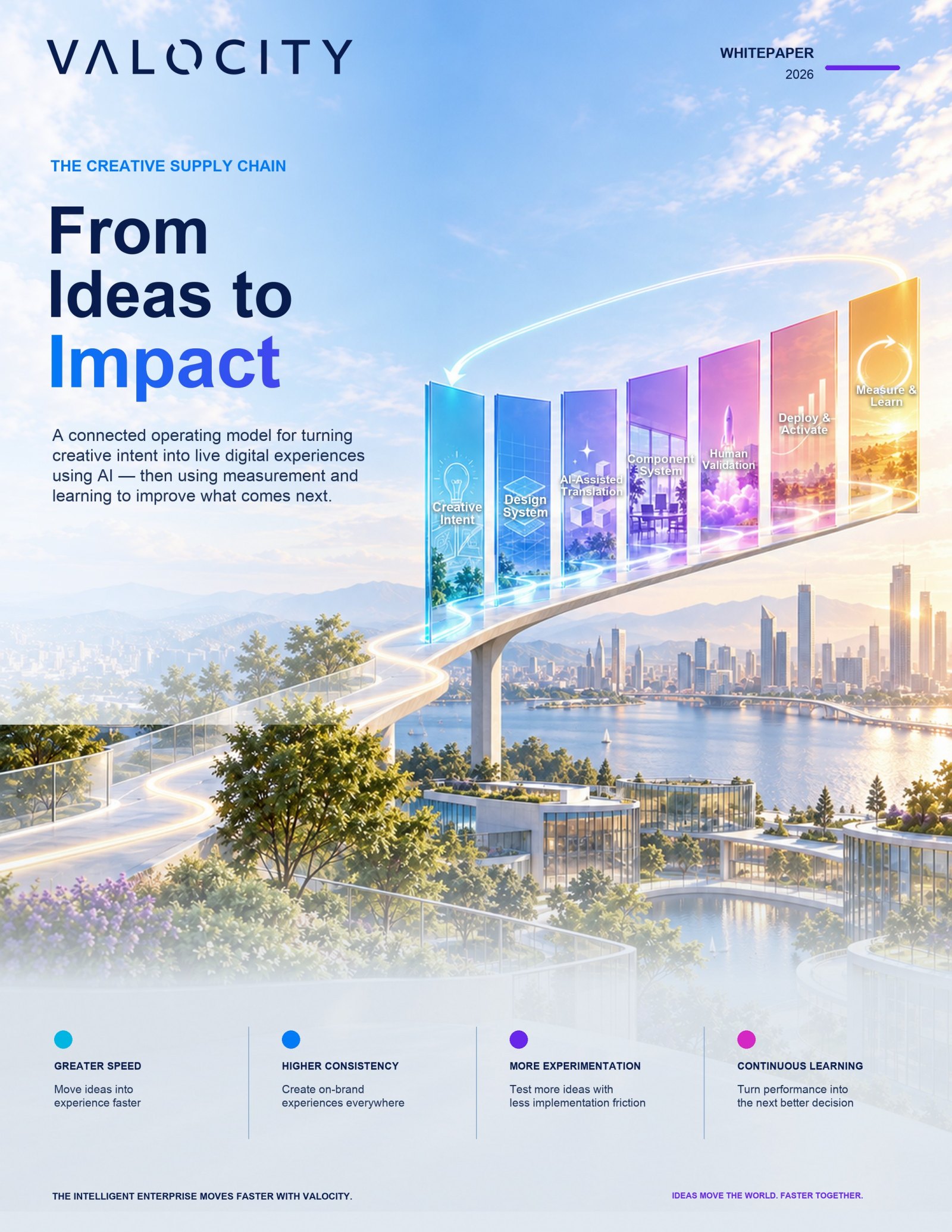
In our new whitepaper, The Creative Supply Chain: From Ideas to Impact, Valocity introduces a connected operating model for turning creative intent into live digital experiences using AI — then using measurement and learning to improve what comes next.
The Hidden Cost of Translation
Meetings, annotations, specifications, reviews, rework. Over time, that friction creates innovation debt: teams start asking how hard an idea will be to build before asking whether it would create a better customer outcome.
And it drags down everything around it. A real-time insight is less useful if it takes six weeks to act on. A personalization platform is less powerful if every new variant needs manual implementation. A modern CI/CD pipeline can deploy code instantly — but it can’t deploy what hasn’t been built yet.
From Handoffs to a Continuous Loop
The Creative Supply Chain replaces the linear strategy-to-launch relay with seven connected motions — Creative Intent, Design System, AI-Assisted Translation, Component System, Human Validation, Deployment & Activation, and Measurement & Learning — so that ideas move from concept to code to customer, and performance flows back into the next decision.
The goal isn’t automation for its own sake. It’s removing low-value translation work so creative and technical teams can spend their time on the decisions that require judgment, expertise and imagination.
Why Now? AI, Grounded in Your Enterprise
AI can already generate code. But a model guessing from a screenshot doesn’t know your components, your standards, or your accessibility and security requirements. The breakthrough comes when AI is connected — through technologies like Model Context Protocol (MCP) — to the design systems, component libraries, documentation and tests your enterprise already trusts.
The result isn’t unrestricted generation. It’s governed reuse at machine speed.
What You’ll Learn
- The seven motions of the Creative Supply Chain and how they form a closed learning loop
- How design systems and component libraries like Storybook become machine-readable, agent-ready knowledge
- The six-layer enabling architecture — and why it matters more than any single tool
- Five places AI creates value today, from design-to-code acceleration to impact analysis
- How to keep speed and governance in balance: where AI acts, and where humans approve
- A six-step plan to get started, plus the measures that prove it’s working
Machines Accelerate. Systems Constrain. Humans Judge.
This isn’t a headcount-reduction play — it’s capacity creation. Developers spend more time on architecture and differentiated work. Designers spend more time improving the experience. Marketers test more ideas because experimentation gets cheaper. And because learning compounds, speed becomes more than efficiency. It becomes competitive advantage.
Download the Whitepaper
Get the full 11-page whitepaper — including the complete architecture model, the implementation roadmap and the metrics that matter — and see how the Creative Supply Chain becomes the execution engine of the Intelligent Enterprise.